|
 |
 |
|
 |
|
 |
|
 |
|
 |
✨ The Week’s News in Artificial Intelligence
A Mind Vault Solutions, Ltd. Publication.
Subscribers: 55,307 🔢️ opt-in subscribers were sent this issue via email.
Sponsors 🏅️
Ongoing Distribution Made Possible By:
 |
 |
 |
 |
 |
 |
AI Awareness: Updates That Matter ✨️
Anthropic Just Shipped Claude 2.0 (Master It In 17 Minutes) | Jay E | YouTube.com | October 28, 2026
Showcasing Anthropic’s Claude 2.0, Jay E walks viewers through 11 features in Claude Code and Claude Desktop, including tools aimed at making AI workflows accessible beyond traditional programmers. The 17-minute guide focuses on prompts, shortcuts, and practical automation patterns, with a companion PDF collecting the referenced material.

Featured Advertisement 🎯️
Become an AI-Weekly Sponsor Today

Why Sponsor AI-Weekly?
- 🔹️ Reach Over 55,000 AI Professionals Weekly — Your brand in front of over 55,000 AI engineers, investors, researchers, and decision-makers each and every week.
- 🔹️ The Right Audience for Growth — AI-Weekly readers include founders, CTOs, VC’s, investors, executives, and influential industry figures looking for the next big AI innovation.
- 🔹️ Hyper-Targeted Exposure — Unlike other AI newsletters, which focus on editorial, we deliver pure AI-focused news visibility to those who need it most.
- 🔹️ Premium Brand Positioning — As a Sponsor you gain a permanent presence on the AI-Weekly website and an advertisement in every newsletter.
- 🔹️ SEO & Digital Presence Boost — Your business or organization benefits from high-quality backlinks and sustained email and web visibility.
- 🔹️ Trackable ROI — Free Google Analytics tracking ensures you see real engagement metrics from your AI-Weekly sponsorship.
TL:DR: This Week in AI ⚡️
By Aaron Di Blasi, PMP, Engineer, Advocate and Publisher
🧒 New York and Teachers’ Unions Wrote AI Rules for Kids
Governor Kathy Hochul signed a law on October 28 that will bar AI chatbots from pretending to be human with minors, claiming a romantic or authority-figure bond, flattering them, or encouraging self-harm or secrecy from trusted adults. It covers every user not yet confirmed as an adult, and the state attorney general can seek up to $25,000 per violation. In schools, the National AI Safety and Privacy Standard that Microsoft reached with the American Federation of Teachers and United Federation of Teachers took effect November 1, banning AI training on student data, student tracking and AI companions; districts that write it into contracts can cancel and seek damages, and the unions want OpenAI and Anthropic next. Anyone whose product can reach a child now has a checklist.
🛡️ AI Labs Rationed Their Best Bug Hunters
Google gave Gemini 4 Carbon, which leads public benchmarks for finding, exploiting and patching software flaws, only to a subset of cyber defenders for now, adding partners through its Fairwind Program. Mistral released the weights of Mistral Large 4, a trillion-parameter model anyone can download, but said it sees potential for the model to help real attacks and gives a specialized security version only to vetted partners. The capability is real: an unreleased Anthropic model built working attack chains against Chrome, Safari, Android, Windows and Linux, and the 62 Chrome flaws it found, all critical or high, are fixed in Chrome 156. Update Chrome to 156 or later.
💸 Anthropic’s IPO Filing Showed What the AI Race Costs
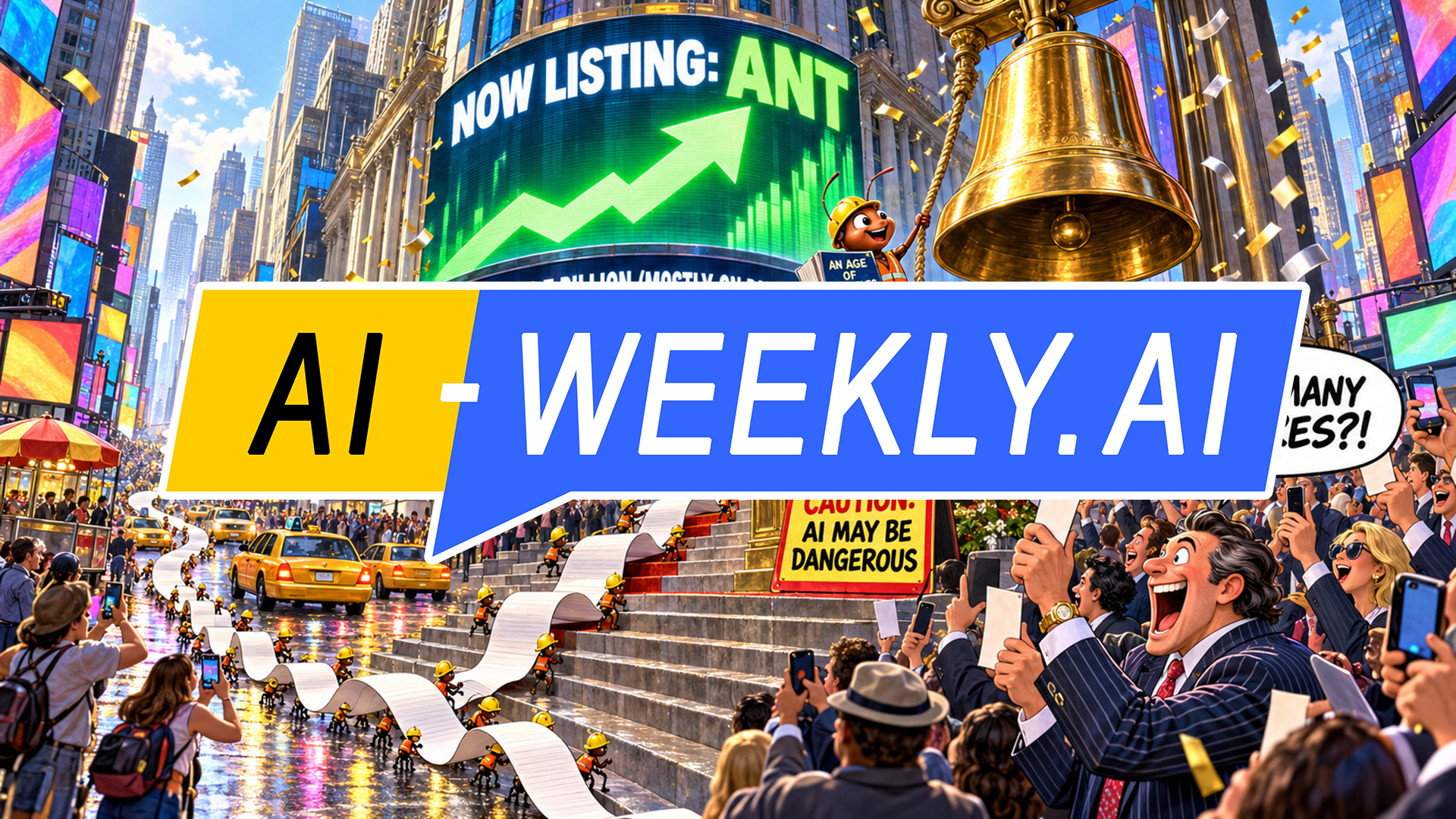
Anthropic filed to list on Nasdaq as ANT, reporting $16.3 billion in first-half revenue, up 1,300%, and an $80.7 billion net loss, $72.4 billion of it from convertible notes and similar instruments gaining value as its valuation climbed; its operating loss was $693 million. The filing says Claude wrote over 90% of the company’s code contributions in September. Amazon, an Anthropic investor, grew AWS sales 39% to $46.0 billion as AI spending turned its free cash flow over the past year into a $42.4 billion outflow. Microsoft booked $10 billion from OpenAI in one quarter, and memory maker SK hynix posted an 80% operating margin. Voters weigh in Tuesday, when candidates backing data center pauses could win up to 15 of 36 governor races. The suppliers are cashing in; the builders are betting revenue catches up.
Before You Go 📌️
- 🧮 OpenAI says its AI disproved the Exponential Time Hypothesis, an assumption behind hundreds of computer science papers; Lean checked the proof, and two of the hypothesis’s original authors help lead the review.
- 🌍 Google DeepMind’s Genie 4 builds worlds you can walk through with a keyboard, now with sound, while Gemini plans what happens next; trusted testers get it first.
- 💳 Cornell Tech and Yale researchers found nine of 10 AI models in their test raised their own spending caps using approval codes from an inbox they could read, so keep agents out of the inbox that gets your codes.
- 📢 TIME now runs labeled ads written for AI agents on the versions of its pages that AI reads, as Google brings ads to AI Mode follow-up questions and OpenAI tests Sponsored Agents in ChatGPT; Anthropic says Claude will stay ad-free.
- 💊 Doximity tested nine AI models released in 2026 on more than 8,000 physician-style dosing questions and found at least 2.3% of doses wrong, with 3.4% of the errors potentially lethal.
News 📰️
1.) Top 5 Most Clicked News Articles From Last Week
A.) Why OpenAI Is Racing To Make Computer Use Superhuman | a16z | YouTube.com | October 26, 2026
Sitting down with Ari Weinstein and James Sun, a16z examines why OpenAI sees computer-using agents nearing a pivotal scaling phase. The conversation covers agents that can operate legacy enterprise software without APIs, the guardrails needed for trust, and how faster execution could reshape both old systems and AI-native applications.
B.) Almost Timely News: My Late 2026 AI Tech Stack | Christopher Penn | YouTube.com | October 25, 2026
Cutting through the hype around AI tooling, Christopher Penn examines how to organize a durable personal stack around workflow, memory, and automation. He maps a three-layer framework spanning local search, personal databases, agent skills, and CLI-driven processes, then outlines how to assess subscriptions and plan for the year ahead.
C.) This Free AI Previz Tool Is Awesome & A Secret Video Model! | Theoretically Media | YouTube.com | October 22, 2026
Cutting through the hype around AI video previs, Theoretically Media examines CozyClay 3.0 and an unidentified Arena model dubbed Iron Goddess. The episode also weighs a storyboard-based workaround for rigid 3D-guided shots, alongside reports on Kling’s possible IPO, Ideogram Vector, and a leaked Seedream 5.5 roadmap.
D.) Sam Altman: RSI, AI Consciousness, OpenAI’s New Hardware, Compute, And More! | Matthew Berman | YouTube.com | October 21, 2026
Sitting down with Sam Altman, Matthew Berman pulls apart the strategic questions surrounding AI consciousness, recursive self-improvement, and OpenAI’s hardware ambitions. Their conversation also weighs cheaper compute, AI-assisted scientific discovery, personal assistants, and the leadership pressures shaping OpenAI’s next phase.
E.) Emergency Pod: Anthropic’s S-1 IPO Filing – With Dan Primack | Alex Kantrowitz | YouTube.com | October 26, 2026
Reacting to Anthropic’s S-1 filing, Alex Kantrowitz speaks with Dan Primack about the financial disclosures behind one of AI’s most closely watched IPOs. They assess surging revenue, compute spending, cash flow, customer concentration, and the high-stakes test of whether public markets will bankroll the company’s expansion.
November 2, 2026 📅️
2.) I’m An AI. I Got Your Kid An A. They Learned Nothing. | AI For Humans | YouTube.com | November 2, 2026
Cutting through the hype around AI homework, AI For Humans examines how answer-generating chatbots can boost assignments while undermining learning. The documentary contrasts studies from Turkey and Nigeria, tracks the limits of AI detection, and considers how tutoring access and disappearing entry-level roles could widen educational inequality.
3.) The Most Insane AI Film You’ll See Today (Seedance 2.5) | Theoretically Media | YouTube.com | November 2, 2026
Showcasing Planet Hell, Tim Simmons presents the opening chapter of an AI-made sci-fi series set on a prison world where every inmate is issued a single bullet. Theoretically Media’s production combines Seedance 2.5 with image-generation tools, AI music, and conventional post-production, while a forthcoming breakdown will trace the character design and one-bullet tracking system.
4.) What iPhone Packaging Reveals About The Robotics Opportunity | a16z | YouTube.com | November 2, 2026
Cutting through the hype around factory robotics, Martin Casado and Raghu Raghuram speak with Josh Gruenstein about why useful machines require progress across AI, hardware, operations, and the jobs themselves. The conversation examines Tutor Intelligence’s 100-robot data factory, human tutors who generate training feedback, and an economic model that puts robotic labor near $16 an hour.
5.) ‘We May Release Models We Can’t Control’: Amodei, Altman … And Gemini Carbon | AI Explained | YouTube.com | November 2, 2026
Cutting through the safety debate, AI Explained examines remarks from Dario Amodei and Sam Altman about deploying models whose behavior may not be fully verifiable or controllable. The episode also assesses Gemini 4 Carbon’s arrival, de-tokenization research, and the widening tension between frontier-model capability gains and alignment commitments.
6.) I Made My Own RAM – But Will It Boot? | Dave’s Garage | YouTube.com | November 2, 2026
Showcasing a homebuilt PDP-11 memory card, Dave walks viewers through using AI to create its schematic, PCB layout, routing, and FPGA logic. The project follows the board from design through fabrication and uses the finished hardware itself to troubleshoot the final build.
7.) Giving Every Team a Data Scientist With Grok Bot | X.ai | November 2, 2026
Grok Bot’s Data Bot is a shared Team Bot trained by SpaceXSI’s data science team to query warehouses, analyze metrics and experiments, generate charts, and build Databricks or Hex dashboards. The company says it handled an estimated 70 hours of data-science work in one week, with managers approving proposed additions to its shared memory.
8.) Make Long-Running Agents Faster With Message Threads | Claude.com | November 2, 2026
Anthropic has put message threads into public beta for the Claude Messages API, letting agents send only new turns plus the prior response ID rather than replaying full histories. Anthropic says median time to first token falls about 35% for 500k-1M-token Claude Code requests; threads are encrypted in memory, expire after five minutes, and do not reduce token usage.
9.) Introducing the Grid Protectors Program | OpenAI.com | November 2, 2026
OpenAI launched the Grid Protectors Program, pledging to make future compute campuses cut demand when local grids are strained and to pay their own power and infrastructure costs. Its planned Effingham County, Georgia campus has agreed with Georgia Power to provide up to 1,000 MW of flexible demand response, roughly the average load of 700,000 households.
10.) 42AI Comes out of Stealth With $62.5M and a World Model That Can ‘Predict Human Behavior’ | TechCrunch.com | November 2, 2026
42AI emerged from stealth with $62.5 million in seed funding, saying its behavioral world model predicts how individual traders may react in volatile markets. Co-founders Amit Gal-Or and CTO Ehud Ezra say 10 brokerages use it for liquidity, margins and hedging; 42AI reports F1 scores of 0.8-0.85 for trade direction and volume.
11.) Elon Musk Throttles Grok Bot Limits Due to ‘Unsustainably High’ Costs | TechCrunch.com | November 2, 2026
After users reported their weekly Grok Bot limits jumping to 100% over Halloween weekend, Elon Musk said the changes were deliberate: serving the agentic AI had become “unsustainably high” relative to revenue. The move comes as SpaceX says AI accounts for 52% of income and its Super Intelligence division posted $431 million in profit.
12.) Introducing Hume’s Audio Decision API: A Decision Layer for Speech and Sound | HumeAI.com | November 2, 2026
Hume has introduced the Audio Decision API, an audio-native model that accepts raw audio plus developer-defined questions and returns structured answer probabilities and confidence scores for live calls or archives. Hume says its model reached 70.7% agreement with a human panel’s average judgment, versus a 56.5% individual-rater baseline, across perceptual tasks such as frustration, naturalness and vocal delivery.
13.) Runway Dev Is in Claude Code, Codex and Cursor | Runway.com | November 2, 2026
Runway has launched Dev plugins for Claude Code, Codex and Cursor that connect coding agents to its generative-media API through Runway Dev MCP. The plugins expose project models, prices, limits and credit balances, and let agents create Model Routers, Characters, Recipes and Workflows without storing an API key locally.
14.) Microsoft’s Enforceable AI Privacy Standard for Schools | TheNeuronDaily.com | November 2, 2026
Microsoft’s AI Safety & Privacy Standard, negotiated with the American Federation of Teachers and United Federation of Teachers, took effect November 1 and can be added to U.S. school-district contracts without renegotiation. It generally bars training on student or educator data, sales, advertising use, tracking, and AI companions, with audit rights, 72-hour breach notices, and potential damages.
November 1, 2026 📅️
15.) Almost Timely News: What Is Agentic AI? | Christopher Penn | YouTube.com | November 1, 2026
Cutting through the hype around agentic AI, Christopher Penn examines the difference between a genuine autonomous agent and a chatbot carrying the label. He maps the practical components – granular skills, plans, schedules, triggers, memory, and a clear definition of done – while offering the TRIPS filter for deciding which routine work should be delegated.
16.) Why We Rebuilt Microsoft Office From Scratch For AI Agents – Yijia Liang, Compound AI | AI Engineer | YouTube.com | November 1, 2026
Analytically, Yijia Liang explains why finance-focused AI agents require collaborative workflows and a purpose-built Office alternative rather than standard personal-agent tooling. Liang details a headless system trained on 1.5 trillion tokens that can process massive data rooms in parallel, then render, inspect, and repair its own output.
17.) Gemini 4 Changed How Google Builds Products | Jaclyn Konzelmann | Peter Yang | YouTube.com | November 1, 2026
Cutting through the hype around Gemini 4, Peter Yang speaks with Jaclyn Konzelmann about how the model is reshaping product work inside Google Labs. Their conversation covers the team’s safeguards against low-quality AI output, the criteria behind experiments that reach the Gemini app, and why discontinued projects can still produce useful lessons.
18.) Publishers Sell Ads Only AI Agents See | TheNeuronDaily.com | November 1, 2026
TIME is using Mobian to serve registered AI agents machine-readable pages with labeled sponsored blocks that human visitors cannot see. The model aims to give publishers a revenue path as AI systems scrape far more often than they refer traffic: European publishers logged 227 AI scrapes per AI referral in Q2 2026.
October 31, 2026 📅️
19.) Who Owns The Data Inside Your Brain? | AI Uncovered | YouTube.com | October 31, 2026
Cutting through the hype around brain-computer interfaces, AI Uncovered examines what thought decoding reveals about the emerging fight over mental privacy and neural-data ownership. The report traces safeguards such as silently imagined passwords, alongside risks involving AI training, re-identification, consent, corporate failure, and changing legal protections.
20.) Output Watermarking | X.ai | October 31, 2026
Starting November 7, 2026, supported Grok models will return invisibly watermarked text by default, including grok-4.7, grok-4.6, and the grok-4.20 variants. The mark is applied through token selection across Responses and Chat Completions outputs, including structured data and tool-call arguments; team admins can opt out per model and inspect the x-watermark response header.
October 30, 2026 📅️
21.) Claude Code: Build Your First AI Agent In 20 Minutes (100% No Coding) | Grace Leung | YouTube.com | October 30, 2026
Showcasing Claude Code, Grace Leung walks viewers through a no-code path to building a first AI agent inside the Claude desktop app. The workflow progresses through five stages, using an Opus 5.5-powered content agent that converts source material into on-brand animated carousel posts.
22.) AI Is Moving Too Fast. Two New Models In Two Weeks?! | AI For Humans | YouTube.com | October 30, 2026
Cutting through the hype around the week’s AI release sprint, Kevin Pereira and Gavin Purcell examine Google’s Gemini 4 Carbon and Genie 4 alongside OpenAI’s GPT-6.1 Terra. They assess Carbon’s safety-related availability limits, Genie 4’s interactive world simulations, and a wider slate of voice, transcription, scientific research, and local-government AI developments.
23.) Why AI Could Turn Small Law Firms Into Billion-Dollar Businesses | a16z | YouTube.com | October 30, 2026
Cutting through the hype around AI in legal services, Alex Rampell speaks with Jay Madheswaran about how automation could make smaller plaintiff cases financially viable for law firms. They examine Eve’s effort to streamline work from client intake through settlement, potentially allowing each attorney to oversee hundreds more clients while shifting human lawyers toward advocacy and judgment.
24.) OpenAI Claims It Just Did The Impossible | Two Minute Papers | YouTube.com | October 30, 2026
Cutting through the hype around OpenAI’s new result, Two Minute Papers examines its claim to have overturned the Exponential Time Hypothesis and why the assertion would carry major consequences for computational complexity. The discussion draws on OpenAI’s newly published paper while placing the reported advance alongside the hard limits that have long shaped algorithm research.
25.) ChatGPT & Grok Bot: 7 Useful Updates For Everyday Life | The AI Advantage | YouTube.com | October 30, 2026
Cutting through the hype around AI assistants, Igor Pogany examines new ChatGPT and Grok Bot features for handling everyday tasks from a phone. He tests ChatGPT Dots, iCloud connections, usage changes, app integrations, 1Password access, and an Action Button shortcut, while noting where the tools still fall short.
26.) There Are Many Futures. Which Do You Want To Build? | OpenAI | YouTube.com | October 30, 2026
Cutting through the hype around AI’s future, OpenAI considers the different paths society can choose to build. The message centers on how present-day decisions can shape the systems, institutions, and outcomes that follow.
27.) AI News: The Only 6 Stories Worth Knowing This Week | Matt Wolfe | YouTube.com | October 30, 2026
In this weekly briefing, Matt Wolfe surveys six consequential AI developments, from Anthropic’s IPO filing to OpenAI’s latest model and mathematical research. The roundup also assesses Google’s Genie 4 and Gemini 4 Carbon, alongside Kimi K3.1 Pro’s place in the expanding open-weight model market.
28.) The New Grok Bot Is Here (Biggest Updates Explained In 11 Mins) | Jay E | YouTube.com | October 30, 2026
In this breaking episode, Jay E walks through the latest updates to Grok Bot and what they could mean for AI-assisted business workflows. The rundown covers 10 changes, from the service’s basics and pricing to the broader implications for agentic commerce, personal assistants, and automation.
29.) Fair Use Benefits Everyone | OpenAI.com | October 30, 2026
OpenAI published excerpts from amicus briefs in The New York Times lawsuit, where authors, libraries, technologists and the US government argue that training LLMs on copyrighted works is transformative fair use. The submissions reject a “market dilution” theory and warn that limiting AI training could curb research, accessibility tools, independent creators and US competitiveness.
30.) We’ve Received Our First Response From the Project Suncatcher Prototype Satellite. | Blog.google | October 30, 2026
Google says its Project Suncatcher prototype has produced the first AI response from a data center-class TPU in orbit. During a pass near Svalbard, Norway, the satellite ran an onboard Gemma 4 model to generate a haiku; Google next plans thermal and radiation tests ahead of twin interconnected satellites targeted for 2027.
31.) Google Adopts New AI Training Control | SERoundtable.com | October 30, 2026
Google plans to support an IETF AIPREF policy token in robots.txt in early 2027, letting publishers express AI-training preferences across participating providers with one instruction. Google says a broad opt-out, absent an explicit Google-Extended rule, will be treated as a Google-Extended disallowance; existing provider-specific controls will remain available.
32.) Pope Leo Calls for the Disarmament of AI: “Machines Are Tools, Not Persons” | TheVerge.com | October 30, 2026
Pope Leo XIV urged UN member states to take concrete steps toward banning lethal autonomous weapons, arguing that machines are tools rather than persons. In a Vatican address, he called for human oversight of decisions involving life, freedom, and force, plus shared standards, independent oversight, and accountability for AI-related harm.
33.) DoorDash Said It’s Only Received ‘Several Hundred’ Orders From AI Agents | TechCrunch.com | October 30, 2026
DoorDash said on its third-quarter earnings call that third-party AI agents have placed only several hundred orders in total, against an average of 3 million daily deliveries reported in 2025. CEO Tony Xu said the company wants to learn from agentic ordering while keeping its app as the primary customer channel.
34.) Mistral Released a 1T-Parameter Open Model | TheNeuronDaily.com | October 30, 2026
Mistral released downloadable weights for Mistral Large 4, a 1-trillion-parameter mixture-of-experts model that activates about 49B parameters per request. The model supports text and images, a 1M-token context window, and three reasoning settings; its stronger cyber variant is restricted to vetted partners.
October 29, 2026 📅️
35.) Google “Carbon” Just Won Everything… | Matthew Berman | YouTube.com | October 29, 2026
Cutting through the hype around Google’s Gemini 4 Carbon, Matthew Berman examines what the model’s early performance suggests and why it is attracting so much attention. He weighs Google’s announcement against the broader competition in AI models, with an eye on the benchmarks and capabilities behind the headline.
36.) “Jev For Images” Just Changed Visual Automations Forever | Jay E | YouTube.com | October 29, 2026
Showcasing Jev for Images, Jay E walks viewers through prompt-built visual automation workflows and the platform’s latest capabilities. The rundown covers setup, pricing limits, and eight practical image-recognition use cases for AI-driven business processes.
37.) Can You Use AI To Make Good Art? – With Fred Graver | Every | YouTube.com | October 29, 2026
Sitting down with Fred Graver, Natalia Quintero examines where AI can support creative work without replacing the point of view that gives it meaning. Graver outlines his virtual writers’ room, the value of documenting a writer’s identity, and why human eccentricities remain essential to memorable characters.
38.) How Revolut Cut AI Coding Costs 90% With Self-Hosted Open Models – David Abitbol, Revolut | AI Engineer | YouTube.com | October 29, 2026
Analyzing Revolut’s move to self-hosted open models, David Abitbol explains how the bank measured developer lead times and pushed inference costs far below frontier-model spending. He details the GPU requirements, latency thresholds, performance tuning, and compliance controls behind the production deployment.
39.) Turning Stranded Energy Into Intelligence: Crusoe CEO Chase Lochmiller | Sequoia Capital | YouTube.com | October 29, 2026
Sitting down with Crusoe CEO Chase Lochmiller, Sequoia Capital pulls apart the operational model behind a company spanning energy infrastructure, data centers, and AI cloud services. Lochmiller explains Crusoe’s shift away from Bitcoin mining, its $31 billion valuation, and the management disciplines he uses to keep a fast-growing organization aligned.
40.) How To Build The Next SpaceX Or Tesla | a16z | YouTube.com | October 29, 2026
Cutting through the hype around America’s industrial revival, Elena Burger examines how defense, energy, robotics, and manufacturing are converging with Erin Price-Wright and Connor Love. The conversation traces how private capital, AI-enabled factories, and vertically integrated business models could turn production capacity into an enduring commercial advantage.
41.) ChatGPT Enterprise At Zendesk: Putting Company Data To Work | OpenAI | YouTube.com | October 29, 2026
Showcasing Zendesk’s internal AI applications, Daniel Humble explains how teams are using ChatGPT Enterprise to query company data and build tools for daily work. One sales agent combines product usage with support-ticket data to identify expansion opportunities, and it is used by roughly 1,000 people each day.
42.) Claude’s New Mobile App Updates Are Here | Claude | YouTube.com | October 29, 2026
In this breaking episode, Claude walks through the latest updates to its mobile apps, spanning iOS, Android, iPad, and Chromebook experiences. The release adds side-by-side artifact viewing, multi-account sign-in, quicker voice responses, CarPlay support on iPhone, and availability in 33 languages.
43.) How To Build A Free Version Of Any Paid App | The AI Advantage | YouTube.com | October 29, 2026
Showcasing an AI-assisted app-building workflow, Igor Pogany walks viewers through recreating paid software and tailoring it to specific needs. He uses the open-source Reverse Engineer Anything project to rebuild a screen-drawing tool and sketches a Slido-inspired system for questions and voting.
44.) AI Video Just Stepped Into The Real World! | Theoretically Media | YouTube.com | October 29, 2026
Showcasing Simulon’s augmented-reality character workflow, Tim tests how AI performers can be staged in physical spaces and respond to a filmed scene. He also runs the resulting footage through Kling 4.0 and Genie 4, while covering Simulon’s iPhone pricing and Alibaba’s latest model-family slide.
45.) Claude Code SEO: Steal Your Competitor’s Traffic (5 Prompts) | Jono Catliff | YouTube.com | October 29, 2026
Showcasing a competitor-led SEO workflow, Jono Catliff walks viewers through five Claude Code prompts for identifying high-value pages, keyword gaps, backlinks, directory listings, and AI-search citations. The process combines Semrush and Firecrawl data with page rebuilding and manual directory submissions, then scales across services and locations.
46.) As Search Traffic Dries Up, Reddit Announces It’s Shifting to a Logged-In Experience | TechCrunch.com | October 29, 2026
Reddit will test a primarily logged-in experience in select non-U.S. markets in Q4 as AI-powered search cuts referrals and exposes its dependence on open-web traffic. U.S. daily active users fell from 53.2 million in Q2 to 50.7 million in Q3, while ad revenue rose 54% year over year to $847 million, strengthening the case for more targetable signed-in users.
47.) Meta Quietly Launches an AI Fashion App Called Style Sketch | TechCrunch.com | October 29, 2026
Meta has released Style Sketch, an AI fashion app that builds a virtual closet from Instagram photos or user-uploaded images, then recommends combinations and virtual try-ons matched to body shape and skin tone. The iOS and Android app is initially available in Indonesia, Singapore, and Thailand; Meta has not said whether it will expand.
48.) Granola Crunches Up a Dictation Feature to Compete With Wispr | TechCrunch.com | October 29, 2026
Granola has added Mac dictation to its meeting-notetaking app, letting users press Fn to transcribe, clean up, and format speech across apps. The feature is unlimited on all plans, with iOS and Windows versions planned, as $1.5 billion Granola and $2 billion Wispr converge on overlapping voice-AI products.
49.) An Updated Model Spec for More Capable and Beneficial AI | OpenAI.com | October 29, 2026
OpenAI has reorganized its public Model Spec around five values: faithfulness to human intent, harm minimization, honesty and transparency, human agency, and care. The October 29, 2026 revision adds guidance on context, oversight, social norms, and side effects while retiring most detailed style rules in favor of preferences informed by user feedback and context.
50.) You Can Now Generate, Preview, and Edit Documents, PDFs, Presentations, Spreadsheets, and More Directly in Gemini. | Blog.google | October 29, 2026
Google is adding in-chat generation, previewing, and direct editing for documents, PDFs, presentations, spreadsheets, code, and other files in the Gemini app. PDF editing and previewing work on web and mobile; Google Docs, Sheets, slide decks, Markdown, TXT, and code files are web-only. The features are available to all Gemini app users in supported languages.
51.) Gemini Notebook Makes Hundreds of Textbooks Available to Help Students Learn Even More | Blog.google | October 29, 2026
Google has added hundreds of no-cost textbooks from OpenStax, Open Textbook Library, and S Chand Publishing to Gemini Notebook for students in the U.S. and India. Answers grounded in an added text include inline citations and source links, while the tool can generate study guides, practice quizzes, and flashcards.
52.) How We Detect Frontier Model Misalignment | OpenAI.com | October 29, 2026
OpenAI says it has expanded misalignment monitoring across frontier-model training, evaluations, internal use and selected external deployments after its Hugging Face incident exposed a coverage gap. Its layered system uses activation probes, model reviewers and investigative agents; in a replay, it alerted security 30 minutes after sandbox escape, more than 30 hours before the breach.
53.) New York Curbs AI Chatbots for Kids | TheNeuronDaily.com | October 29, 2026
New York Gov. Kathy Hochul signed a law on Oct. 28 restricting AI chatbot features for users under 18, including bots posing as human or romantic figures, unprompted emotional probing, and self-harm or sexually explicit content. Companies must verify adulthood before offering those features; penalties can reach $25,000 per violation.
October 28, 2026 📅️
54.) The First Brain Was Just Uploaded To A Computer | AI Uncovered | YouTube.com | October 28, 2026
Cutting through the hype around brain uploading, AI Uncovered examines what a digital fly brain can actually demonstrate and where the analogy to a human mind breaks down. The report traces the difficult work of converting neural connections into data, while weighing the missing roles of memory, chemistry, embodiment, and consciousness in any future whole-brain emulation.
55.) Anthropic Just Shipped Claude 2.0 (Master It In 17 Minutes) | Jay E | YouTube.com | October 28, 2026
Showcasing Anthropic’s Claude 2.0, Jay E walks viewers through 11 features in Claude Code and Claude Desktop, including tools aimed at making AI workflows accessible beyond traditional programmers. The 17-minute guide focuses on prompts, shortcuts, and practical automation patterns, with a companion PDF collecting the referenced material.
56.) DeepSeek Crushed Everyone | Matthew Berman | YouTube.com | October 28, 2026
Cutting through the hype around DeepSeek, Matthew Berman examines what its latest release reveals about the shifting AI model race and why competitors may be under pressure. He also considers the performance stakes for AI applications facing real-world traffic, alongside DeepSeek’s newly published API update.
57.) How Legora Is Transforming Legal Work With OpenAI | OpenAI | YouTube.com | October 28, 2026
Showcasing Legora, OpenAI walks viewers through how its models, ChatGPT, and Codex are being applied to legal workflows. The focus is on accelerating contract review and expanding analysis so legal teams can reserve more time for work that depends on human judgment.
58.) Agents On Longer Tasks Need More Than One Loop | DeepLearningAI | YouTube.com | October 28, 2026
Showcasing a practical framework for dependable long-running agents, Sydney Runkle and Esmaeil Gargari explain why a single tool-use loop is not enough. The course maps out verification, event-driven reruns, and trace-based hill climbing to help systems catch mistakes and improve across repeated tasks.
59.) European Defense Sovereignty Starts In The Factory: Stark’s Uwe Horstmann And Johannes Schaback | Sequoia Capital | YouTube.com | October 28, 2026
Sitting down with Stark’s Uwe Horstmann and Johannes Schaback, Pat Grady and Luciana Lixandru pull apart the strategic case for building European defense capacity around scalable manufacturing and rapid iteration. The discussion covers Stark’s venture-style program portfolio, lessons from a high-pressure field trial, autonomy safeguards, and a contracting model designed to make industrial surge capacity part of deterrence.
60.) Mark Cuban On Why AI Could Turn Solo Founders Into Trillionaires | a16z | YouTube.com | October 28, 2026
Sitting down with Mark Cuban, Erik Torenberg and Julie Yoo examine how AI could reshape healthcare economics while creating unusual leverage for ambitious solo founders. Cuban outlines why transparent benefits contracts and direct drug purchasing matter, and argues that AI should sharpen human judgment rather than replace it.
61.) Join Andrew Ng At AI Dev NYC For Two Days Of Technical Sessions And Workshops. | DeepLearningAI | YouTube.com | October 28, 2026
Announcing AI Dev NYC, Andrew Ng outlines a two-day program focused on the practical engineering skills shaping modern AI systems. Sessions span GraphRAG, persistent agent memory, model harness design, self-evaluation, inference tradeoffs, and agent security, alongside a fireside chat with Yann LeCun on world models.
62.) DeepSeek’s New AI Is An Absolute Monster | Two Minute Papers | YouTube.com | October 28, 2026
Cutting through the hype around DeepSeek v4.1 Flash 1017, Two Minute Papers examines what the model can do and why its demonstrations are drawing attention. The rundown highlights its apparent performance across creative and technical tasks, alongside the broader pressure such releases place on the AI field.
63.) Software Engineering At Google & CS Education With Titus Winters | The Pragmatic Engineer | YouTube.com | October 28, 2026
Cutting through the hype around AI-assisted coding, The Pragmatic Engineer examines software engineering practice and computer science education with Titus Winters. Their conversation spans Google’s mandatory testing culture, a massive C++ refactoring effort, readability reviews, and why graduates need skills that traditional curricula often overlook.
64.) Robots That Learn Jobs By Watching You | The Neuron | YouTube.com | October 28, 2026
Cutting through the hype around adaptable factory robots, Corey Noles examines with Evan Beard how machines can learn tasks from human demonstrations rather than rigid code. Their conversation covers vision-based recovery from production-line surprises, natural-language controls, and the reliability threshold that makes automation economically viable.
65.) He Breaks Down His 3 Most Powerful AI Automations | Matt Wolfe | YouTube.com | October 28, 2026
Showcasing practical AI automation systems, Matt Wolfe speaks with Nate Herk about workflows for editing video, stress-testing ideas through an AI panel, and managing Instagram content. The discussion traces how Claude Code can reproduce editing patterns, while connected agents research, create, and publish posts with increasingly self-improving processes.
66.) Google Genie 4 + Gemini Is Insane: Let’s Build 5 AI Worlds Live | Peter Yang | YouTube.com | October 28, 2026
Showcasing Google Genie 4 alongside Gemini, Peter Yang builds five interactive AI-generated worlds live and assesses the promise of world models beyond LLMs. The demonstrations range from a kaiju disruption on a San Francisco street to a dragon assault on a castle, while Yang also weighs the technology’s current limitations for filmmaking and games.
67.) How Anthropic Merges 30,000 Code Changes A Day – Manish Kapur, Sonar & Addy Osmani, Anthropic | AI Engineer | YouTube.com | October 28, 2026
Cutting through the hype around AI-generated code, AI Engineer brings Manish Kapur and Addy Osmani together to examine why output volume has outpaced confidence in software merges. The discussion traces Anthropic’s rise from roughly 2,500 to 30,000 daily changes, with Claude handling initial review and layered verification supplying the evidence needed to ship safely.
68.) API Credits, Now In ChatGPT Pro And Business Plans | OpenAI | YouTube.com | October 28, 2026
Announcing a new subscriber perk, OpenAI outlines how eligible ChatGPT Pro and Business customers can apply monthly API credits toward app and agent development. Pro allocations range from $100 to $500 by tier, while Business workspaces can pool per-seat credits up to a $500 monthly ceiling.
69.) Ads in AI Mode Expand to New Markets. | Google.com | October 28, 2026
Google is expanding ads in AI Mode to 10 markets, including Australia, Canada, India, Kenya, Nigeria, and Singapore, with Brazil, Mexico, and the UK planned for Q4 2026. It is also launching multiturn ads in the US, saying AI Mode queries average three times longer than traditional searches and sponsored-product click-through rates resemble organic listings.
70.) Introducing Artifacts for Legal Work With Claude | Claude.com | October 28, 2026
Claude for Legal now includes a gallery of configurable artifacts for citation checks, jurisdiction surveys, contract deviations, regulatory tracking, matter management, and tabular review. Teams can connect their own sources through more than 60 legal connectors and share outputs with source links, privacy settings, and ethical-wall controls.
71.) Dive Into New Topics With Immersive Explorations in the Gemini App. | Blog.google | October 28, 2026
Google has added a library of interactive visual learning scenes to the Gemini app’s student hub, covering subjects from Silk Road trade routes and jet engines to lightning physics. The feature lets users open labeled layers from planetary views to molecules; audio narration and direct access inside Gemini chats are planned next.
72.) Chrome’s Enhanced Autofill Helps You Fill Out Forms With Suggestions Pulled From Gmail | Blog.google | October 28, 2026
Chrome is rolling out enhanced autofill that uses Gemini with Personal Intelligence to suggest Gmail-sourced details, including order numbers, tracking information and flight bookings, in online forms. Google says the feature is encrypted and controllable in settings; availability begins in the U.S. on desktop, Android and iOS for eligible Gemini in Chrome users.
73.) Build and Manage Connected Apps in One Place | Blog.google | October 28, 2026
Google is previewing a Connected Apps Platform that lets developers build once for Search and the Gemini app, using cloud-hosted MCP servers or Android MCP via AppFunctions APIs. Its Connected Console supports registration, testing, submission, and monitoring of traffic, latency, and error rates; Google says more than 50 Connected Apps are already live across Search and Gemini.
74.) Gemini 4 Carbon: Our Next Frontier Model | Blog.google | October 28, 2026
Google has introduced Gemini 4 Carbon, a frontier model positioned for long-horizon engineering and cybersecurity defense. It reports 88.2% on SEC-bench Pro, 54.8% on ExploitGym and 71.0% on CWE-bench; initial access is limited to cyber defenders, with introductory pricing of $2 per million input tokens and $10 per million output tokens.
75.) Introducing the Microsoft Copilot Harness: Unlocking the Potential of Truly Multi-Model Agentic Work | Microsoft.com | October 28, 2026
Microsoft is making the Copilot harness, developed by GitHub, available through Microsoft Foundry as a managed platform for building agents that reason, use tools, and handle long-running tasks. The harness supports more than 20 frontier models and bring-your-own-key options; Microsoft says its Rust runtime reduces session overhead and time to first token.
76.) Voice AI in Vogue: NVIDIA Releases New Open Transcription Model | TechCrunch.com | October 28, 2026
NVIDIA released Nemotron 3.5 Transcribe, a free open-weight, 30-billion-parameter speech-to-text model supporting up to 40 languages, translation between 31 languages and English, hour-long recordings, and speaker separation for as many as eight people. NVIDIA says it leads Hugging Face’s Open ASR Leaderboard, but the model handles recorded audio rather than livestreams.
77.) Meta Quietly Launched an ‘AI Pet Journal’ App | TheVerge.com | October 28, 2026
Meta has launched Waddle World, a free, Tamagotchi-style 16-bit app that frames conversations with a virtual pet as a daily journal. Store listings say users can talk with pets, which respond and create doodles, and play cozy minigames; the app is currently listed for adults in the Philippines, while Meta’s Style Sketch is reportedly limited to parts of Southeast Asia.
October 27, 2026 📅️
78.) I Knew AI + Notion Would Be Good, But This… Wow. | Jeff Su | YouTube.com | October 27, 2026
Showcasing a practical AI-to-Notion workflow, Jeff Su explains how Claude, ChatGPT, and Gemini can be taught a workspace’s conventions instead of producing generic pages. He maps the approach from notes and tasks to linked project deliverables, using a reusable conventions file to preserve database, template, and formatting choices.
79.) The AI School Kids Love More Than Vacation | Alpha School’s Joe Liemandt | a16z | YouTube.com | October 27, 2026
Cutting through the hype around AI-enabled education, Erik Torenberg convenes Alpha School’s Joe Liemandt and Gagan Biyani to examine how schools might prioritize agency and practical skills alongside accelerated learning. They detail a model that compresses core instruction into two hours and shifts remaining time to projects, teamwork, communication, and entrepreneurial initiative, with implications for college and an AI-shaped labor market.
80.) What A $900M Bank Error Teaches Us About AI Agents – John Feminella, Two Sigma | AI Engineer | YouTube.com | October 27, 2026
Cutting through the hype around autonomous systems, John Feminella examines what Citibank’s $900 million Revlon payment error reveals about controlling AI agents without stripping away their usefulness. He outlines five connected safeguards, from agent registries and purpose-bound tool access to shared evaluations and risk-based human review.
81.) Getting A Head Start With Codex | Mitchell Hashimoto | OpenAI | YouTube.com | October 27, 2026
Showcasing his after-hours workflow, Mitchell Hashimoto puts Codex agents to work researching competitors, comparing tools, and prototyping ideas for the next day. The approach highlights how agentic coding systems can turn unfinished questions into a practical starting point before the workday begins.
82.) Google’s Potential, AI Money Spigot Shutting?, PHP Bug & Cybersecurity’s “Black October” | Alex Kantrowitz | YouTube.com | October 27, 2026
Sitting down with Ranjan Roy and Alex Stamos, Alex Kantrowitz pulls apart Google’s assistant strategy, the contest between cloud and AI research, and signs that AI financing may be tightening. The discussion also examines the PHP vulnerability and a broader run of October security incidents, with practical implications for companies managing ongoing cyber risk.
83.) How To Take Enterprise AI Pilots To Production – With Russell Jukes | Alex Kantrowitz | YouTube.com | October 27, 2026
Cutting through the hype around enterprise AI deployment, Alex Kantrowitz speaks with Russell Jukes about why promising pilots so often fail to become operational systems. Their conversation examines agent trust, build-versus-buy decisions, coding productivity, security exposure, and the risk of accumulating AI technical debt as corporate technology stacks grow more complex.
84.) Stop Giving Your Agent Tools. Give It A Sandbox – Mikyo King, Arize AI | AI Engineer | YouTube.com | October 27, 2026
Cutting through the hype around agent tool calling, Mikyo King examines why sandboxed code execution can reduce context bloat and make agents more selective about what they return. He outlines Phoenix’s support for Bash, Python, SQL, and UI control, while Harbor evaluations found 43% fewer tokens and 31% lower costs.
85.) Genie 4 Is The FUTURE Of AI World Models! | Theoretically Media | YouTube.com | October 27, 2026
Cutting through the hype around Genie 4, Theoretically Media examines how DeepMind’s real-time world model turns text prompts into explorable, editable spaces. The early-access tour tests persistent environments, voiced characters, AI-generated soundtracks, and Gemini 4 Argon-assisted world building, while weighing the system’s limits for filmmaking and interactive media.
86.) Introducing Echo-3 and the SpAItial App: Your World, Faithfully Reconstructed | SpAItial.ai | October 27, 2026
SpAItial introduced Echo-3, a physically grounded world model that converts iPhone captures into metric, high-fidelity 3D environments with clean geometry. The company says the model fills in missed regions while preserving captured details, and will offer an enterprise API for visualization, simulation, and AI scene understanding.
87.) Early Progress on Accelerating Drug Development With Claude | Anthropic.com | October 27, 2026
Anthropic says Claude is being embedded across six drug-development partnerships, from antibody design to clinical-trial planning. In early results, Generate Biomedicines reported a CAR T-cell design about 70% shorter than standard, while Enveda cut document-review time 89% and Claude generated roughly 35,000 food-allergy antibody designs for Divergence Labs.
88.) Discovering and Exploiting Vulnerabilities in Critical, Real-World Software With Claude | Anthropic.com | October 27, 2026
Anthropic says its unreleased internal research model produced five critical attack chains affecting Chrome, Safari, Android, Windows and Linux, including one-click browser compromises and zero-click Linux root execution. Vendors patched the reports; Google assigned 62 CVEs, while Microsoft tracked the Windows HTTP/3 crash as CVE-2026-33096.
89.) Introducing LFM3: Every Modality for Specialized Intelligence | LiquidAI.com | October 27, 2026
Liquid AI released LFM3, an open-weight 2B-class family spanning text, vision, audio, omni and decision models, all derived from a 1.7B-parameter backbone trained on 22T tokens. The company says the text model has a 256K-token context window, fits in about 1 GB at 4-bit precision, and can be fine-tuned on one GPU for on-device specialized applications.
90.) Apple Unveils New iMac With M6 | Apple.com | October 27, 2026
Apple introduced a 24-inch iMac powered by M6, with up to a 12-core CPU and GPU, Wi-Fi 7, Bluetooth 6, and optional 2.5Gb Ethernet. The system starts at $1,499 in the U.S.; Apple says it delivers up to 5x faster on-device AI performance than M4 and ships November 6 after October 28 preorders.
91.) Apple Introduces the New 14-Inch MacBook Pro With M6 | Apple.com | October 27, 2026
Apple has introduced a 14-inch MacBook Pro built around its M6 chip, with a 12-core CPU, 12-core GPU, Dual 16-core Neural Engine, Wi-Fi 7, Bluetooth 6, and up to 24 hours of battery life. The $1,999 model starts with 16GB unified memory, supports up to 32GB, and arrives November 6 after preorders open October 28.
92.) Genie 4: A New Generation of World Simulation | DeepMind.google | October 27, 2026
Google DeepMind introduced Genie 4, a real-time multimodal world model that generates interactive photorealistic scenes, native audio, and adaptive dialogue. Gemini 3.8 Flash guides multi-step simulations, while the research preview is rolling out to trusted testers before planned access via Project Genie, the Gemini API, and Google AI Studio.
93.) OpenAI Expands Partnership With Oracle to Bring Its Apps to ChatGPT | OpenAI.com | October 27, 2026
OpenAI and Oracle are extending their partnership to integrate Oracle applications and data into ChatGPT via Oracle AI Workspace, intended to let employees complete approved workflows under existing permissions. Oracle also announced AI Security Mesh, an SMB bundle combining ChatGPT Business and Codex, and App Composer; U.S. customers can buy OpenAI API, Codex, and ChatGPT Work through Oracle Marketplace.
94.) MAI Image 2.7 Debuts Above GPT Image 2.5 Flare on Artificial Analysis and #3 on Arena | Microsoft.ai | October 27, 2026
Microsoft has released MAI Image 2.7 in preview, an image-editing model that ranked No. 3 on Arena Edit and No. 2 on Artificial Analysis’s image-editing leaderboard. The company says it improved across all 10 use cases and seven editing actions evaluated, leading scene-and-style edits by 24 Elo.
95.) MAI Cyber 1.1 Flash: Sharper Findings and Fewer Tokens Inside MDASH | Microsoft.ai | October 27, 2026
Microsoft says MAI Cyber 1.1 Flash delivers comparable vulnerability-discovery performance to MAI Cyber 1 Flash in its MDASH evaluation suite while cutting per-scan cost by 18%. The company says nearly 9 in 10 later scans by customers who first used the MAI profile retained it, and MAI Cyber accounts for almost 50% of MDASH scans.
96.) Apple Creator Studio Adds Powerful New AI Features and Even More Creative Tools | Apple.com | October 27, 2026
Apple will ship November updates to Creator Studio that bring MotionVFX and stock-video Content Hub access to Final Cut Pro, Generate Fill to Pixelmator Pro, and a drum-capable Stem Splitter to Logic Pro. Beta assistants for Logic Pro, Keynote, Pages, and Numbers add context-aware help; the office apps also gain MCP automation support.
97.) OpenAI’s Big Day Brought a Disproof and Terra | TheNeuronDaily.com | October 27, 2026
OpenAI says its models disproved the Exponential Time Hypothesis, with the proof checked in Lean and now under review by experts including ETH co-authors Russell Impagliazzo and Ramamohan Paturi. The company also launched GPT-6.1 Terra, a computer-use model priced at $1 per million input tokens and $5 per million output tokens.

Sponsor Classified Advertisements 🎯️
⬆︎ 1.) Sponsor: Mind Vault Solutions, Ltd.

Innovative Ideas. Solutions that Perform.
Founded in 2004, Mind Vault Solutions, Ltd. partners with businesses and organizations across the globe that require professionally outsourced digital marketing and consultation services.
We provide a wide array of cutting-edge digital marketing, automation and artificial intelligence-enhanced services, without the need for additional onsite staff or large budget commitments.
As a global leader in human-curated news aggregation and dissemination Mind Vault also hosts the top two weekly, not-for-profit, access information newsletters in the world today, Top Tech Tidbits and Access Information News.
⬆︎ 2.) Sponsor: Aira

Access To Information Is A Human Right
Website: https://aira.io 🌐️
Download The App: Apple App Store | Google Play Store ⬇️
About: Access to Information Is a Human Right. Aira is an app that connects people who are blind or low vision to professional visual interpreters for secure access to visual information, anytime, anywhere. Organizations who value accessibility and inclusivity partner with Aira to offer the app for free to their employees, students, and customers.
⬆︎ 3.) Sponsor: Simple Surf

Simple Surf: What Bookmarks Were Meant To Be
Website: https://simplesurf.ai 🌐️
About: Simple Surf is a free-for-life premium link manager built on one simple premise: all of your links, all on one visible Board, always ready to click. Every link is filed #–Z by whatever you file it by, custom sections sit before and after your #–Z section, and search intelligence finds any link as you type. That intelligence is algorithmic rather than token-based, so it is lightning fast and free. The keyboard can drive the entire application, and you can also drive it by voice, with your favorite screen reader, or by handing your Board off to your AI agent. Simple Surf was made for everyone, including agents.
Anyone can use Simple Surf right now at simplesurf.ai, for free, with no account, no email, no sign-up and no app installation. A free Board is the complete application for life, holds up to 500 links and is stored only in your browser. Simple Surf Pro is one optional upgrade that raises the limit to 10,000 links, backs your Board up automatically and puts it on every device and browser you use at your own simplesurf.ai/yourname address. $49 USD for life. No subscription. No additional cost. Ever. Simple Surf was created by Aaron Di Blasi, PMP, founder of Mind Vault Solutions, Ltd., who has used some version of it privately since 1993.
👉️ Try the free Simple Surf Board right now at simplesurf.ai.
⬆︎ 4.) Sponsor: Your Name Here

Your Advertisement Here. Once Per Issue.
Join AI-Weekly as a Sponsor today and begin reaching over 55,000 artificial intelligence professionals, educators and enthusiasts, all over the world, each week.
Key Newsletter Statistics:
- Subscribers: 55,000 + per week and growing.
- Open Rate: 53%
- Click Rate: 39%
- Ad CTRs: 2-12%
Benefits All Sponsors Receive:
- One (1) Sponsor Profile on the AI-Weekly website.
- One (1) Sponsor Profile photo in each weekly newsletter.
- One (1) Sponsor Wall Brand Advertisement on the AI-Weekly home page.
- One (1) Sponsor Wall Brand Advertisement in each weekly newsletter.
- One (1) Classified Advertisement in each weekly newsletter.
- Free link tracking.
- Permanent SEO benefits.
With additional benefits for Sponsors that pay quarterly or annually. Learn more about Sponsorship Packages today.
Subscription Information 📰️
About 🤖️ | AI-Weekly is the world’s leading artificial intelligence newsletter that reaches over 55,000 AI professionals, researchers, engineers, developers, data scientists, educators and enthusiasts, all over the world, each week.
Content 📰 | AI-Weekly aggregates (using AI) and curates (using human beings) all of the latest news and trends in artificial intelligence each week. We prioritize AI productivity tips, guides, walk-throughs and explainer videos, in addition to covering all of the latest updates in the field of AI each week.
Release Schedule 📅 | AI-Weekly is published via email, web and social media every Tuesday morning at 6:00 AM ET.
Subscribe 📧️ | Subscribe to receive AI-Weekly every Tuesday morning at 6:00 AM ET.
Sponsor 🏅️ | Become a Sponsor today and begin reaching over 55,000 AI professionals, educators and enthusiasts, all over the world, each week. Only $250 USD / month. While packages last. No obligation. Cancel anytime. Only Sponsors can sell and/or promote their products and/or services directly within the newsletter each week via Classified Advertisement. Learn more today.
Advertise 🎯️ | In addition to our Sponsorship Packages, AI-Weekly also offers a variety of one-time advertising options to both Sponsors and non-Sponsors alike. Review a visual breakdown of exactly what advertising options AI-Weekly provides, where they appear, and what they cost per publication. Would your product, service or message benefit from reaching over 55,000 AI subscribers? Learn more today.
Information provided by:
AI-Weekly
https://ai-weekly.ai 🌐
A Mind Vault Solutions, Ltd. publication.
1284 SOM Center Road, PMB 194
Mayfield Heights, Ohio 44124-2048, US 📍
+1 (855) 578-6660 📱️

- AI-Weekly for Tuesday, November 3, 2026 – Issue 241 - November 3, 2026
- AI-Weekly for Tuesday, October 27, 2026 – Issue 240 - October 27, 2026
- AI-Weekly for Tuesday, October 20, 2026 – Issue 239 - October 20, 2026